

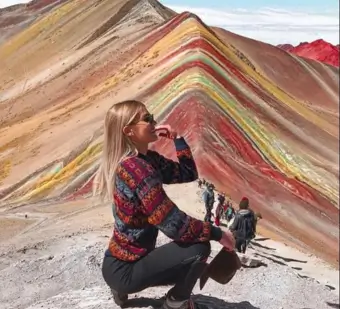
Vinicunca, locally known as the Mountain of Colors and internationally recognized as Rainbow Mountain Peru, has become one of the most striking natural destinations in the southern Andes. Located in the Vilcanota mountain range at over 5,000 meters (16,400 ft) above sea level, this geological formation stands out for its intense natural color bands created by mineral deposits exposed after millions of years of tectonic activity and erosion.
But Vinicunca is not just a viral photograph. It is a true high altitude experience, where travelers face the real challenge of Andean elevation, cross landscapes dominated by the majestic Ausangate, and walk through territories that, until only a few years ago, were traveled exclusively by local communities and alpaca herders.
From the operational experience of Machu Picchu Explorators, we know that many visitors arrive without fully understanding what this hike truly involves. For that reason, this guide is designed to provide real, detailed, and technical information on how to prepare, what to expect, the genuine level of difficulty, how weather conditions influence the experience, what to pack, and how to explore Vinicunca safely and memorably.
You won’t find superficial descriptions here. Instead, you’ll discover a complete explanation to help you plan your visit to Rainbow Mountain from Cusco with professional criteria and fully enjoy one of Peru’s most extraordinary landscapes.
Where Is Vinicunca and Why Does Its Location Make It a High Altitude Challenge?
Vinicunca (Rainbow Mountain) is located in the Vilcanota mountain range, one of the most imposing Andean chains in southern Peru. This region is dominated by the sacred Ausangate (6,384 m / 20,945 ft), a revered peak for Andean communities and a major climatic force that shapes the entire surrounding landscape.
Reaching Vinicunca means crossing vast high altitude plains where the terrain already exceeds 4,500 meters (14,760 ft) above sea level before the hike even begins. This is a critical detail: visitors start walking at an elevation that, in most countries, would already be considered extreme high mountain terrain.
From the daily operational experience of Machu Picchu Explorators, we know that the determining factor here is not the distance itself, but the body’s physiological response to hypoxia (low oxygen levels).
At this altitude, walking, breathing, speaking, and moving forward become actions that require awareness, pacing, and controlled effort. Vinicunca is not technically complex, but its elevation transforms it into a genuine high-altitude challenge that demands proper acclimatization and realistic expectations.
The Complete Geological Explanation: Why Vinicunca Is Unique in the World
Vinicunca is not simply a colorful landscape it is the visible result of millions of years of geological transformation.
Millions of years ago, this region was covered by sediment deposits accumulated in ancient bodies of water. These sediments were rich in diverse minerals which, during the tectonic uplift that formed the Andes, were gradually pushed upward and exposed.
Over thousands of years, wind, rain, ice, and intense high altitude solar radiation eroded the surface layers, eventually revealing the mineralized internal strata that create today’s striking color bands.
Each color corresponds to a distinct chemical composition:
- Red: Hematite and iron oxides
- Yellow: Limonite and sulfide compounds
- Green: Chlorite and copper-based minerals
- White: Quartz and calcareous sandstone
- Brown and purple tones: Mixtures of oxidized mineral compounds
This type of visible stratified mineralization is extremely rare on the planet. For that reason, Vinicunca is not only a tourism icon but also a site of geological interest, studied for its sedimentary history, tectonic evolution, and mineral composition.
Its beauty is not artificial, nor is it seasonal it is the exposed anatomy of the Andes themselves.
The Real Difficulty Explained Through Physiology – Not Distance
Many blogs describe Vinicunca as an “easy short hike.” This creates misleading expectations.
At Rainbow Mountain, the true challenge is not the number of kilometers it is how the human body responds to extreme altitude.
Here, the body faces:
- Reduced oxygen levels, which increase heart rate and respiratory demand
- A final incline with loose gravel, requiring balance and controlled footing
- Cold Andean winds, which significantly lower the perceived temperature
- Intense solar radiation, accelerating dehydration even in cool weather
At over 5,000 meters (16,400 ft), oxygen availability drops considerably compared to sea level. As a result, simple actions such as walking, speaking, or maintaining rhythm require conscious effort.
For this reason, pacing must be slow, steady, and deliberate.
At Machu Picchu Explorators, we guide our travelers with strategic pauses designed to regulate breathing, stabilize heart rate, and prevent premature fatigue. Proper altitude management transforms the experience from overwhelming to empowering.
Vinicunca is not technically complex but physiologically, it demands respect.
Detailed Month by Month Weather and How It Impacts the Experience
Vinicunca has an extreme and highly variable high Andean climate. Weather conditions are one of the most important factors shaping the overall experience.
April – October (Dry Season)
- Clear early mornings
- Sharper, more vibrant mountain colors
- Intense cold at sunrise
- Lower probability of rain
This period is generally considered the most stable season for visiting. The mineral bands appear more defined under direct sunlight, especially during early hours.
November – March (Rainy Season)
- Increased cloud cover
- Possible muddy sections along the trail
- Greener surrounding landscapes
- Occasional afternoon showers
While rain can partially obscure visibility at times, the scenery becomes more dramatic and lush, offering a different photographic perspective.
Temperatures can shift dramatically within a few hours from around 0°C (32°F) at dawn to a warm thermal sensation by midday due to intense solar radiation at over 5,000 meters above sea level.
This sharp fluctuation explains why a proper layering system is not optional but essential. Visitors must be prepared to adapt quickly to cold wind, strong sun exposure, and sudden weather changes sometimes all within the same morning.
In high altitude environments like Vinicunca, preparation directly determines comfort and safety.
How the Route Is Truly Experienced: A Complete Timeline of the Day
The experience begins around 4:00 a.m. in Cusco. After several hours on the road, travelers stop for breakfast in a local Andean community.
Upon arriving at the trailhead, the scenery is already impressive: vast open highland plains, herds of alpacas grazing freely, and the imposing Ausangate dominating the horizon.
The first section of the hike allows hikers to gradually adapt their pace and continue acclimatizing to the altitude. The second section the final ascent demands focused breathing and controlled rhythm.
When reaching the summit viewpoint of Vinicunca, the visual impact fully compensates for the effort. The layered mineral colors stretching across the mountain create a landscape that feels almost surreal, especially under clear Andean skies.
Real Risks and Professional Prevention of Altitude Sickness
Vinicunca is one of the places where poor acclimatization becomes most evident. At over 5,000 meters (16,400 ft), altitude stress is not theoretical it is physiological.
From the field experience of Machu Picchu Explorators, proper prevention is the key factor that determines whether the experience is empowering or overwhelming.
Key recommendations:
- Spend at least two full days in Cusco before the hike
- Maintain constant hydration starting the day before the tour
- Avoid alcohol and heavy meals prior to the excursion
- Use trekking poles to reduce muscular strain and improve stability
- Practice deep, controlled breathing and maintain a slow, steady pace
Altitude sickness is not about physical strength it is about how your body adapts to reduced oxygen availability. Preparation makes the difference.
Vinicunca vs. Palccoyo: An Informed Decision Based on Your Profile
Both mountains offer colorful mineral formations, but the experience differs significantly between Vinicunca and Palccoyo.
| Factor | Vinicunca | Palccoyo |
|---|---|---|
| Altitude | ~5,036 m | ~4,900 m |
| Physical Effort | High | Moderate |
| Hiking Time | ~3 hours | ~1 hour |
| Visitor Volume | Higher | Lower |
| Experience Style | Iconic and dramatic | Panoramic and quieter |
Vinicunca offers the classic, world famous Rainbow Mountain image more demanding, but more iconic.
Palccoyo, on the other hand, provides multiple colorful peaks with a shorter and less strenuous walk, making it a strong alternative for travelers seeking scenery without extreme altitude exposure.
The right choice depends on your acclimatization level, physical condition, and the type of experience you are looking for.
Final Recommendation from Machu Picchu Explorators
Visiting Vinicunca Rainbow Mountain is not a race to reach the viewpoint first. It is a true high-altitude experience where a traveler’s success is defined not by speed, but by how the hike is approached.
At over 5,000 meters (16,400 ft) above sea level, the body functions differently. Breathing becomes more intentional, your pace must remain steady, and rest naturally becomes part of the journey. Understanding this before starting the hike completely transforms the experience. Vinicunca is best enjoyed when travelers accept that altitude, weather, and personal rhythm set the rules.
From our operational experience at Machu Picchu Explorators, we know that those who arrive properly acclimatized in Cusco, use a correct layering system, wear appropriate hiking boots, stay consistently hydrated, and walk without rushing not only reach the viewpoint without complications they truly enjoy the landscape, take photographs calmly, and connect with the Andean environment dominated by the majestic Ausangate and the vast highland plains.
Rainbow Mountain rewards preparation.
It rewards the traveler who plans ahead.
It rewards those who understand this is not a conventional excursion, but a short expedition under high-mountain conditions.
With the right equipment, responsible planning, and professional guidance from Machu Picchu Explorators, Vinicunca stops being a physical challenge and becomes one of the most powerful, authentic, and unforgettable highlights of your journey to Cusco.